May 19, 2026
This article highlights the work carried out in TWINVEST Task 5.2, which focuses on siting, sizing and wake-effect modelling for future wind farms. Within the wider TWINVEST framework, the work is linked to the Environment and Earth Platform by helping users compare layout options and estimate likely energy production at an early stage, when decisions still need to be made under uncertainty. The task is therefore less about final design and more about giving a structured, repeatable basis for feasibility screening and scenario comparison.
A key insight from the task is that wake losses should be treated as first-order design issues. The position, spacing, and alignment of turbines can strongly affect how much energy a windfarm will ultimately produce, because turbines operating in the wake of others experience reduced inflow and altered turbulence. This means that siting and sizing cannot rely only on simple geometric placement rules. Rather, wake-aware evaluation must be built in directly into the workflow and assessment for comparing candidate layouts and turbine options.
Another essential finding is that feasibility-stage modelling needs to balance speed, transparency and fidelity. The task therefore combines two complementary approaches: a transparent baseline wake model that can be used as a stable engineering reference, and a hybrid physics-guided machine-learning model designed to evaluate many candidate layouts more efficiently while still preserving physically meaningful behaviour. The purpose is not to replace detailed engineering studies later in development, but to improve the quality of early screening by making layout comparisons faster, more traceable and more consistent.
The task also shows that wake modelling should not be treated in isolation. The methodology is built as a modular workflow that can incorporate site wind climate, terrain-related inflow effects, and even possible influence from neighbouring windfarms where relevant. This is key because early windfarm decisions are rarely driven by a single variable. A more realistic screening workflow needs to show how layout, wake losses and site conditions interact, while remaining light enough for repeated optimisation runs.
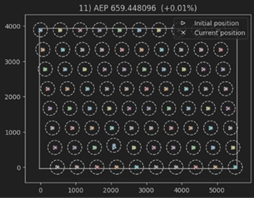
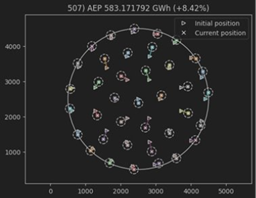
Visuals: Highlighting the wake-effect model (left) and layout optimisation framework (right) developed to support early-stage wind farm siting and sizing.
Overall, the task’s main message is that better siting and sizing starts with better structured comparisons. By combining wake-aware energy-yield estimation, optimisation logic, and modular site effects into one methodology, the task creates a practical foundation for comparing wind farm concepts before more detailed project data are available. In that sense, its value lies in turning early-stage uncertainty into something more systematic, transparent, and useful for downstream decision support in the wider scope of the TWINVEST Digital Twin.
Featured visual: Adobe Stock