May 19, 2026
This article is based on the public TWINVEST deliverable D3.3 – Energy Storage Assets and Flexibility, which explores how storage can strengthen the technical and economic case for future onshore wind projects. Within the TWINVEST project, this topic belongs in the wider umbrella of Investment Conditions Platform, which looks at the market, regulatory, and technical conditions that influence investment decisions for windfarms across the European landscape. The wider TWINVEST framework positions this platform as one part of a universal, open-source, and cybersecure Digital Twin for smarter onshore wind planning and operation.
A central message emerging from the deliverable is that energy storage is not a uniform solution; its value depends on the role it is expected to play. The document distinguishes between three main categories of storage included in the Battery Energy Storage System (BESS) library:
- High‑energy batteries (typically NMC), which offer high energy density and are better suited for long‑duration storage needs.
- High‑power batteries (typically LFP), which prioritise fast response, cycling capability, and thermal stability, making them suitable where quick grid services are required.
- Second‑life batteries, which open a path toward cost reduction and sustainability by repurposing used EV batteries, though with added uncertainty around degradation, safety, and standardisation.
The deliverable also discusses innovative technologies such as vanadium redox flow batteries, compressed‑air energy storage, pumped hydro, and hydrogen systems, which highlights that while some are not yet included in the library due to commercial maturity constraints, they represent important future options for long‑duration flexibility.
A major point underscored throughout the deliverable is that storage should be evaluated through a full life‑cycle perspective. Instead of focusing solely on upfront cost, the report presents a structured view of capital expenditure, operational expenditure, and end‑of‑life costs. This includes batteries, PCS units, thermal management, civil works, maintenance, augmentation, insurance, compliance, dismantling, transportation, and recycling. Assessing these factors together establishes a more realistic picture of long‑term value and financial viability, aligning with how wind farm investments are typically assessed.
Safety and reliability are treated as essential prerequisite rather than add-ons. The systems in the library are evaluated using recognised IEC standards, like IEC 62620 (for performance, capacity, cycle life, and structural designations) and IEC 62485-5 (for safe installation, electrical protection, ventilation, fire safety, and emergency procedures). By embedding these standards into the selection process, the deliverable ensures that storage options are not only technically capable, but also compliant, robust, and suitable for deployment into real world windfarm environments.
An important practical output of the work is the development of the Battery Energy Storage System (BESS) Library. This library organises commercially available high‑energy, high‑power, and second‑life systems into a structured database that supports investor decision‑making. Its development followed a phased process:
- Phase 1: Data collection from manufacturers, market sources, and IEC standards.
- Phase 2: Structuring the library into sub‑categories aligned with different battery chemistries and use‑cases.
- Phase 3: Validation of the systems against performance and safety requirements.
The deliverable also describes how this library will be integrated into the TWINVEST Digital Twin. Using standardised data exchange interfaces, such as RESTful APIs, the library feeds technical and financial parameters directly into the Digital Twin’s modelling environment. This allows the system to generate pre-filtered storage options based on project characteristics, including battery chemistry, storage duration, capacity requirements, CAPEX and OPEX projections, and potential end-of-life costs. The accompanying BESS Library Decision Flowchart illustrates this process clearly, starting from basic project inputs such as wind farm capacity and ancillary service needs, the process helps identify whether an optimal storage solution can be selected from the database or manually chosen from the library. This makes storage selection a structured, traceable, and transparent process.
Overall, the findings of the work points to a simple conclusion, that storage can play a significant role in improving flexibility, grid support, and economic performance of onshore windfarms. However, the best solution depends on aligning the storage technology with its technical function, cost structure, safety requirements, and the project context. By arranging these factors into a clear decision‑support framework, the TWINVEST project helps turn storage from a general concept into a practical, evidence‑based tool for better wind investment decisions.
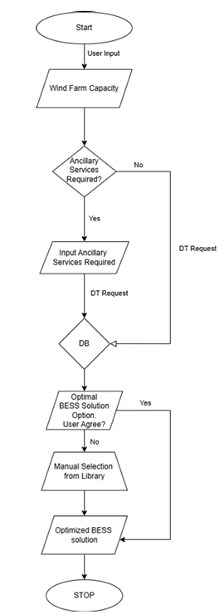
Figure label: BESS Library Decision Flowchart