May 19, 2026
This article is based on the public TWINVEST deliverable D4.4 – Integrated Bottom-up & Top-down, which brings together the work behind the Components to Farm platform. Within the TWINVEST project, this platform is intended to provide the foundation for modelling a windfarm’s nominal energy production and predicted CAPEX from design to operation. In practice, two complementary ways of looking at a windfarm are discussed: a bottom-up approach and a top-down approach, and specifically how these are combined into one integrated framework for the Digital Twin.
A key message of the work is that neither of these two approaches is sufficient alone. The bottom-up approach, led by the University of Surrey (US), starts from the component level and builds upwards. It models turbine behaviour from first principles, inclusive of the aerodynamics, drivetrain, generator, pitch and torque control, operating states, and then extends this logic to farm level through wake interactions and electrical aggregations. This makes it especially useful for understanding how a turbine or a windfarm would behave under given technical conditions, and for exploring certain what-if scenarios. However, on its own, it is more computationally demanding and less naturally expressed in the KPI language used in day-to-day decision-making.
Alternatively, the top-down approach, developed in TWINVEST by NTNU, starts from operational data instead. It is built around SCADA and related measurements, and focuses on KPI computation, benchmarking, and anomaly detection. In other words, it gives users a quicker, higher-level insight of the windfarm performance. This type of overview is most tailored and beneficial to operators and investors. Similarly, on its own, this approach has less ability to explain why a deviation occurs or how the farm might perform beyond the range of the already observed operational data.
The real value of the work lies in exhibiting how these two approaches can be harmonised. The bottom-up framework gives depth, while the top-down framework gives breadth. By integrating them, the Digital Twin can compare measured KPI performance with a physics-based baselines under the same conditions. This opens the door to richer benchmarking, more meaningful anomaly detection, and more transparent root-cause analysis. It also makes it possible to test alternative operational strategies in the same KPI language that users already rely on.
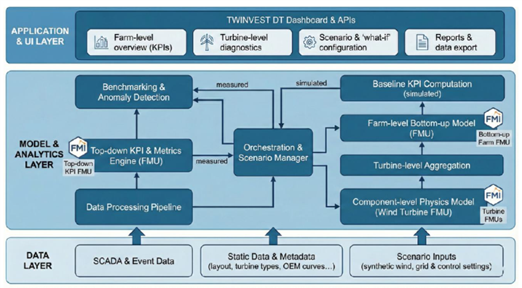
To make this work, the integrated framework is organised around a layered architecture. At the data level, SCADA and event data, static metadata, and scenario inputs are collected and aligned. In the model and analytics layer, the top-down branch processes data and computes KPIs, while the bottom-up branch runs turbine- and farm-level models through orchestrated simulation. Their outputs are then compared in a benchmarking and anomaly-detection module. Finally, the results are exposed to users through the dashboard and APIs. The deliverable defines this as a modular, loosely coupled framework, designed to remain open, extensible and interoperable as the wider TWINVEST Digital Twin evolves.
Results show why this matters for real users. The integrated framework is linked to a set of representative use cases, which includes assessing current wind farm performance, supporting investment decisions for an existing wind farm, validating and calibrating predictive models, optimising turbine-specific performance, and generating compliance and reporting outputs. Across these cases, the common idea is that users should be able to move from a high-level KPI view to deeper technical insight without leaving the same framework.
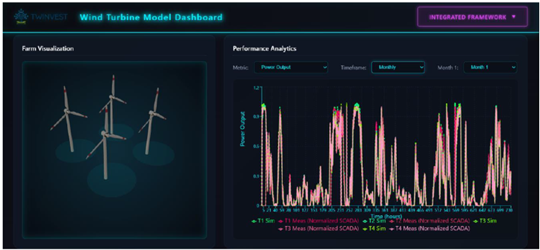
Proof-of-concept dashboard integrated view, including the 3D farm visualisation and both measured (top-down) and simulated (bottom-up) values for the turbine power outputs
In order to demonstrate its feasibility, a proof-of-concept prototype is presented in the deliverable using an anonymised industrial onshore windfarm case. The dashboard allows users to switch between farm-level and turbine-level views, and compare measured top-down values, simulated bottom-up values, and the integrated view side by side. According to the deliverable, the integrated model achieved better predictive performance than either the stand-alone top-down or bottom-up approaches, while still preserving the KPI-oriented and interpretable view required by stakeholders.
Overall, the work highlights that the Components to Farm Platform is not just about assembling models, but about creating a practical bridge between detailed engineering simulation and operational performance assessment. By combining bottom-up and top-down approaches in one coherent Digital Twin framework, TWINVEST moves closer to a system that can support both wind farm operation and longer-term investment decisions.
Featured visual: Integrated bottom-up and top-down framework architecture